the associative fugue
eye see, therefore i am
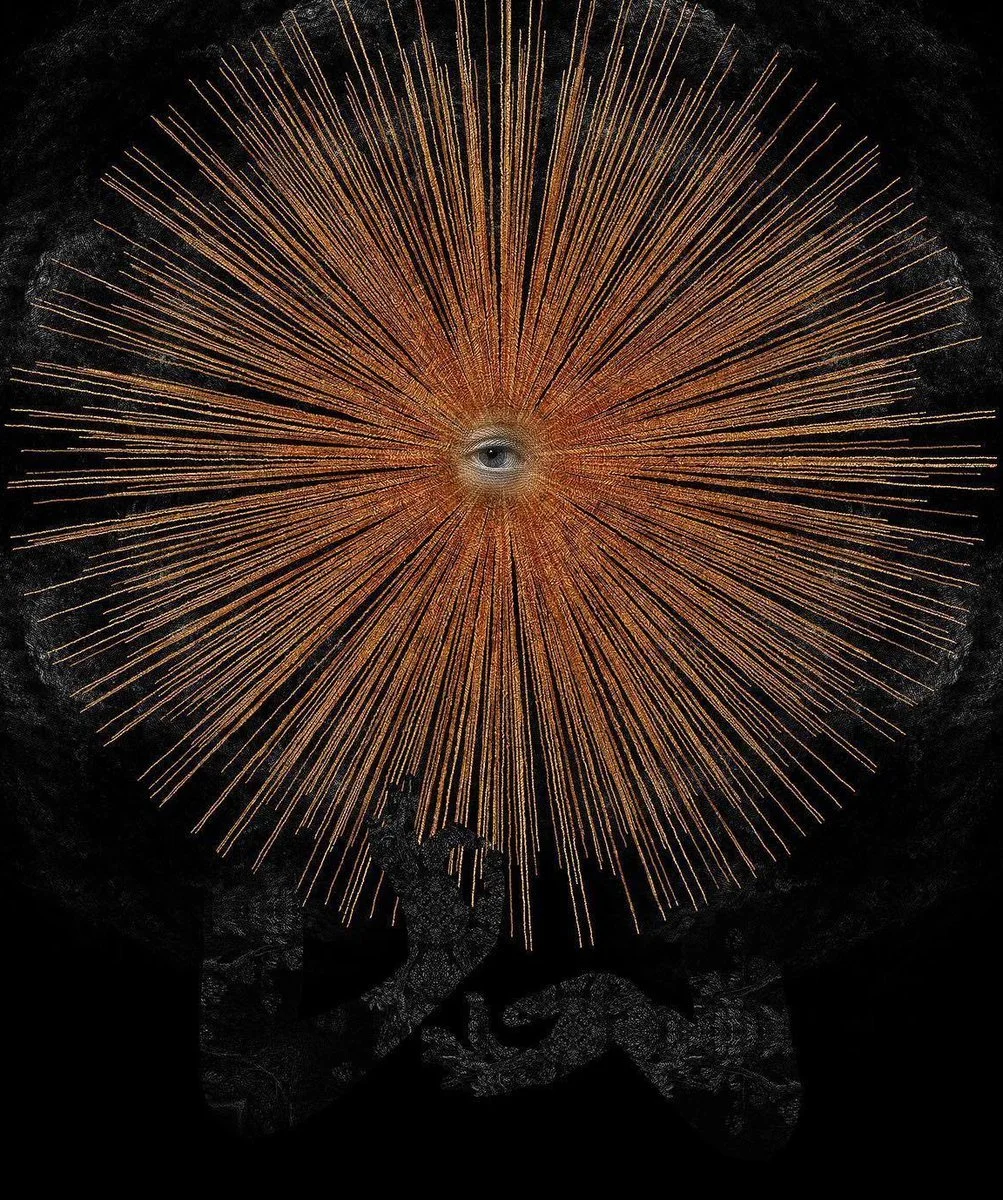
“The Eye of Nature” by Dan Hilliard
Seen firsthand, there is only one thing in the universe, if at all… and it is the eye itself. And even the thingness of that ‘thing’ is behind the lens.
Sight is not out there, nor is it conclusively in here. It is the in between. The space of visual perception is also the container for which these abstractions form the walls.
Consider the monadic, enclosed, singly-lensed eye as a concave theater, the fovea of the retina the stage, and the retina itself a wet and less differentiated compound eye, in contrast to the convex and discretized eye of the insect. The architecture of the monadic eye converges perception toward focal point, as opposed to the diffuse and highly spatially complex field of the insect. This contrast tectonically steers the entire informational and symbolic order downstream of lensed sight.
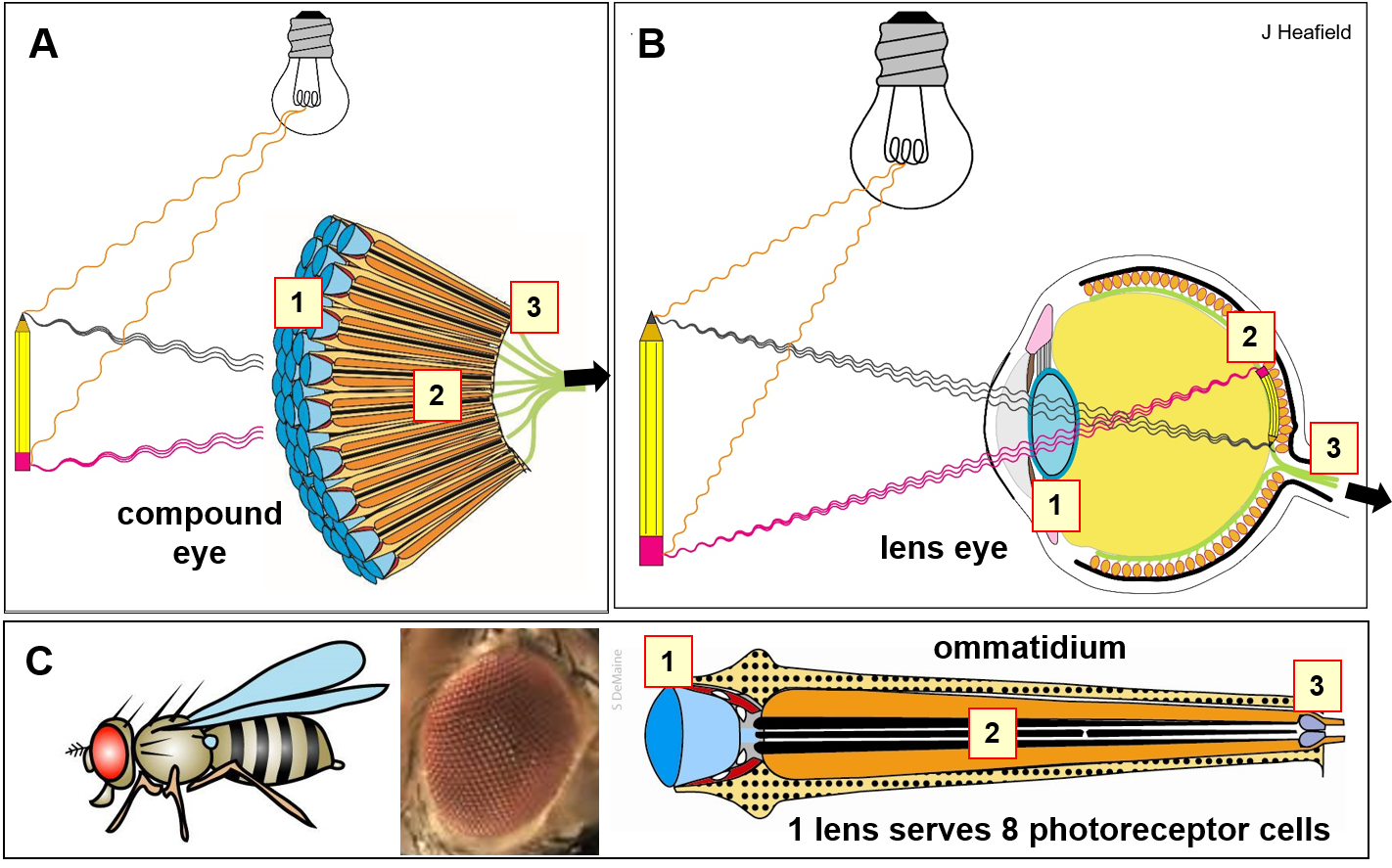
From this comparison alone, it is reasonable to conclude that the abstraction of biological vision emerges in metabolic choreography and protein goo in its primacy, and then further into higher dimensional compound abstraction in the anatomy and optics of a given eye atop the photoreception.
Seeing as sight is fleshy, the notion of the Cartesian theater crumbles! That which would hold that the eye is beaming onto a fully disembodied projector screen somewhere in the aether, somehow also phenomenologically behind the eyes, cannot hold its own assertion up.
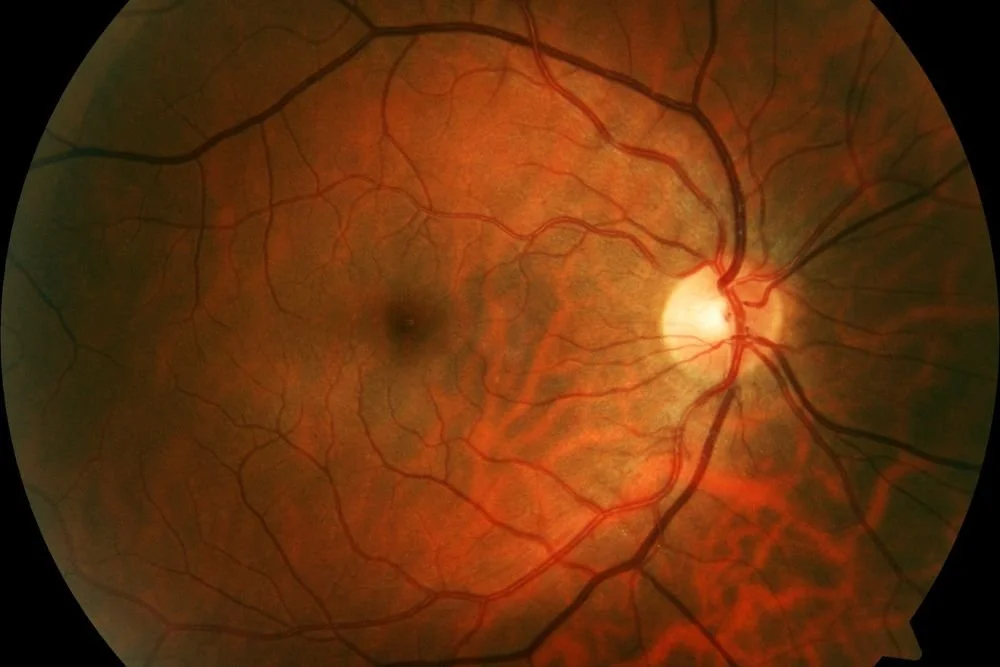
Retinal vasculature; the shadowy spot within the fine branches is the fovea, the bright locus is the optic nerve.
The blood vessels enabling this all in our eyes are, after all, positioned in front of the retina, pulsing away, constantly being adjusted for both their motion and the reticulate branching negative space they form, more unique than a fingerprint.
Further on this uniqueness, no photoreceptor’s specific reception of light, no ocular lens shape, no ocular atrium geometry, no vitreous humor, no retinal metabolism nor metabolic byproduct clearance nor vasculature nor vascular efficiency nor rod/cone-nerve junction anatomy, nor optic nerve organization nor optic nerve metabolism, nor nor nor nor nor… not one of the uncountable single links in the vast strange loop chain of vision are the same across single bodies, even across the midline of a body from one eye to the other.
So not only is it fleshy, it is specific to our flesh, your seeing yours and my seeing mine. Each of us see through the shadow of the body, the ripples of our heartbeats. Our sight, in so many ways, rumbles and glows likewise with the inmost choreography of our very living itself.
The body is then empirically in the way of the “perfect” image—yet there is no image without body.
The body is choreographically and architecturally organized around maintaining, participating in, and processing vision.
It is well known that an outsized proportion of metabolic activity in the body occurs in the small locus of the brain, and that the majority of this metabolic activity goes to integrating vision with somatic and sensory information to construct the controlled synesthesia that steers perception into a form woven with motor planning that is a substrate for phenomenological consciousness.
But the most metabolically intensive issue per cell is not the brain—it is the retina.
Retinal tissue is the most metabolically active tissue in the entire body, consuming 50% more oxygen and producing orders of magnitude more of numerous metabolic byproducts than brain tissue.
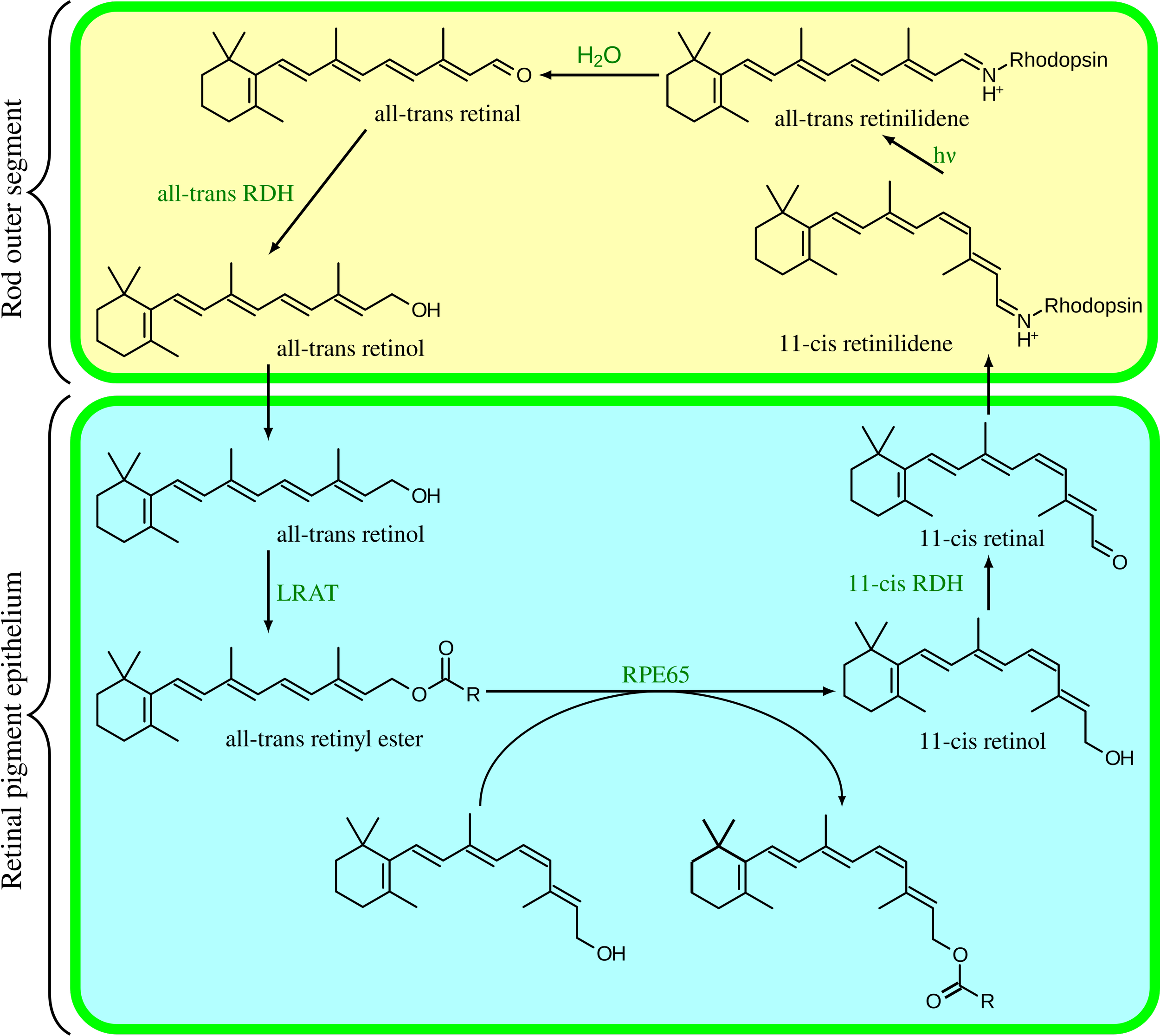
The visual cycle, one among many processes renewing constantly at high volume in the retina. Very metabolically expensive.
Doubling down on this, the eye’s rectus muscles contract more frequently in a day than even the heart. Heart, the diaphragm, the digestive system, and the musculoskeletal ensemble—of all muscles in the entire body, it is those of eye that are most frequently activated.
Our ways of seeing are part and parcel of our choreographies of living, moving too—seeing as the dance of the eyes is our primary motor focus.
Therefore there is no platonic eye. All the eyes that exist and ever have still do not saturate the space of all possible eyes.
It is also quite difficult to delineate the eye from brain; the retina and optic nerve can be thought of as extensions of brain matter out of the skull, though evolutionarily this development went in reverse.
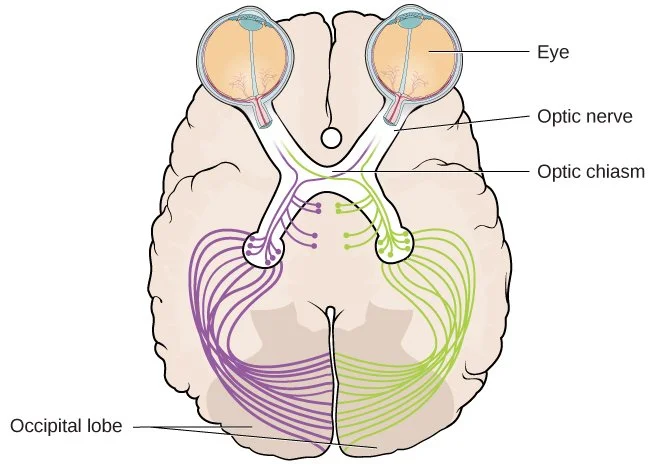
The eyes are the terminus of a dense tract of brain tissue protruding out of the skull by way of the eye sockets.
This genealogy of eye before brain echoes in endogenous psychopharmacology. Serotonin receptors, among many other G-protein coupled receptors integral to the coordination of brain activity and inference across sensory and somatic inputs to help maintain the organs, are rhodopsin-like proteins, evolutionarily derivative of the opsin proteins that respond to light in photoreceptive tissues across the ecological web, from the human retina down to the dinoflagellate erythropsidinium, which has the smallest codified eye structure known as part of its single cell.
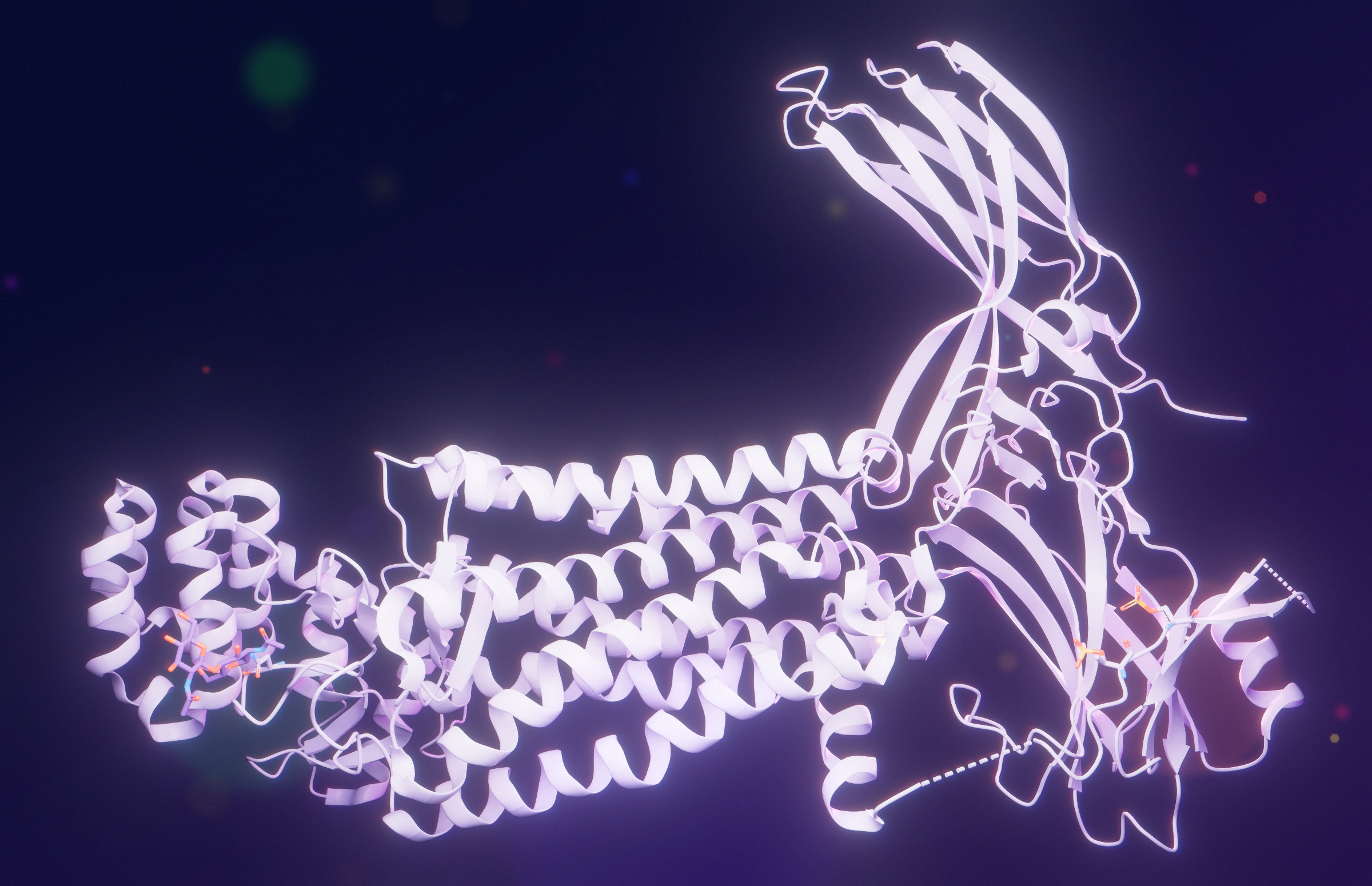
Model of a generic rhodopsin receptor protein crystal structure.
Also subtextual here is that the rhodopsin receptor family are a subtype of the opsins—which is to say, opsins came first. This is supported in the evolutionary tree, in fact, our friend erythropsidinium can help us. Possessing an eye as a single cell, lacking distinct neural tissue, there is a direct evolutionary referent demonstrating the utilitarian primacy of the eye, and the optically oriented nervous system as a secondary force multiplying faculty.
Not only is eye the progenitor of brain, it is the progenitor of the architecture of multimodal somatosensory entanglement in the mammal and other organisms with nervous systems. The neural faculties of sight are not, theoretically, constrained from making sense of that beyond sight, or adjacent to sight; in fact, this is how sensory cognition works. The emergent cymatic of sensory fields perturbing form an informational map for the cortex to inference on and engage, or refrain from engaging, motor pathways. But I digress on this.
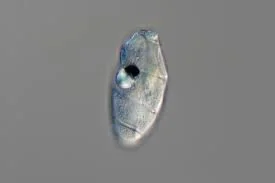
erythropsidinium
Back to the earlier point: If erythropsidinium sees with an eye in lineage with ours, we must consider what that means for the place of our sight in the overall family of seeing beings. Is our sight the conclusive sight? Preposterous. Is single focal point sight the conclusive way of seeing for life? Preposterous, too.
This evident arbitrariness of sorts leads to an interesting juncture.
Seeing as our opsins can only register signals from the wavelengths that pass through water in the vitreous body within the eye (the rainbow)—an artifact from our marine evolutionary ancestors’ ways of life—there are already very specific incentives baked into our psychophysics.
Let’s extend the chain of contingency—seeing through a liquid medium behind a liquid-filled lens, and then through air, there is already an inherent abstraction built into the optics alone. Absent the ampullae of Lorenzini possessed by sharks to detect prey electrically at range, or their lateral line which senses vibration at distance (elegantly collapsing the dichotomy between sound and touch, by the way,) evolution converged on ranged optical perception as the primary mode of environmental externally focused perception and vigilance for us, so we are in a class still narrower within all of ecology.
Yet further, we see this spectrum in a spatial mode oriented toward single point focus at distance, collapsing the visual field into a flattened spatial plane, three dimensional inference arising only from calculating divergence between two flat planes; the spatial world is thus a well informed daydream. And then in signal processing, from the retina to the brain, rapid (high frequency) difference is the primary cue for perceptual registry, whether from luminant or chromatic contrast, or from the motion of an object at some distance, or the movement of our own body in locomotion or active stabilization while standing reveals parallax and thus detail.
What doesn’t move, or what is extremely slow, goes essentially unnoticed except if we move in reference to it.
Seeing anything, anything at all, as we do, is incredibly contingent on the precise and very specific situation the human being finds themselves in within the spatial environment and incentive structures of survival.
If the architecture of our sight and seeing is this narrowly situated, we have a lot less ground to stand on regarding any semblance of knowing with conclusion even from sight, perhaps the most informationally salient sense (salience vis a vis language, conceptual thinking, situationally reactive thought; touch, proprioception, and subperceptual interoception are the bedrock of all somatosensory inference).
And so firsthand, it simply must be that there is no “perfect” image, no true image, not even to the eye itself; the eye may be the very barrier between image and truth altogether. Sight is not unbroken, sight is not final; sight is transitory, vision is passage.
The glances never contained the whole picture. The fragments never fit perfectly, and yet there appears a wholeness in their assemblage either way.
Sight is not without filter. Sight, more accurately, is what survives after available information in the form of energy passes through an extremely fine and contingent stack of filters.
The basis of the image is not what’s there; the basis of the image is the removal of essentially all that is.
So what even is an eye? Is “the eye” even confined to the surface-facing anatomical structure? Seeing as the localized brain evolved after the localized eye, a strong argument could be made that it is not confined whatsoever to the ocular atrium. Far from it. The ocular atrium isn’t even necessary.
The eye is, in fleshy terms, secondary to anatomical void, built upon with tissue through which light enters and affects an organism. The eye is a sort of high dimensional pore, or even a benign, maybe sinthomic, congenital wound—a reverse symptom buffering the harsh existential conditions impinging on the organism, a point where contradictions meet and hold one another steady against collapse—quite literally a wound where the light enters.
Perhaps, more simply put, the eye is void rupturing void, form within emptiness, emptiness within form.
The eye was never a peephole shunting light into terminal nothingness, no—the eye is where the energy held in all that can be seen returns home to the current of all of that which is.
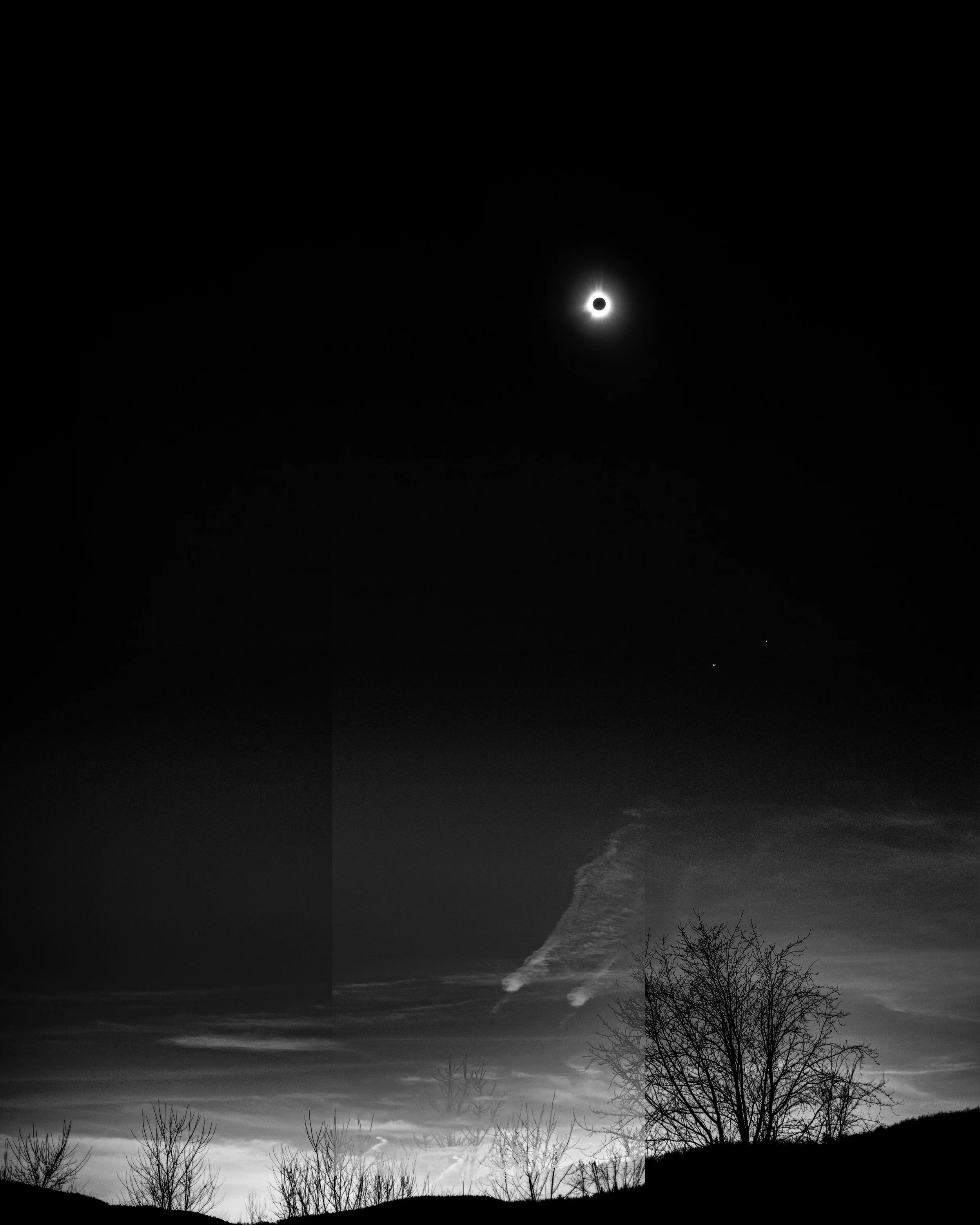
being and nothingness, 2024
for sale: murder weapon, used
{ getting crushed by it is a rite of passage, Iris Yaun, 2026 }
In 1983, the industrial chemical titan Union Carbide commissioned and built a gleaming modernist headquarters hidden between ridges in the hills of Danbury, Connecticut, officially known as the Union Carbide Corporate Center.
This unusually shaped nerve center, with ten branching wings splaying out from two central parking structures, sat elevated above the surrounding landscape, obscured from public view.
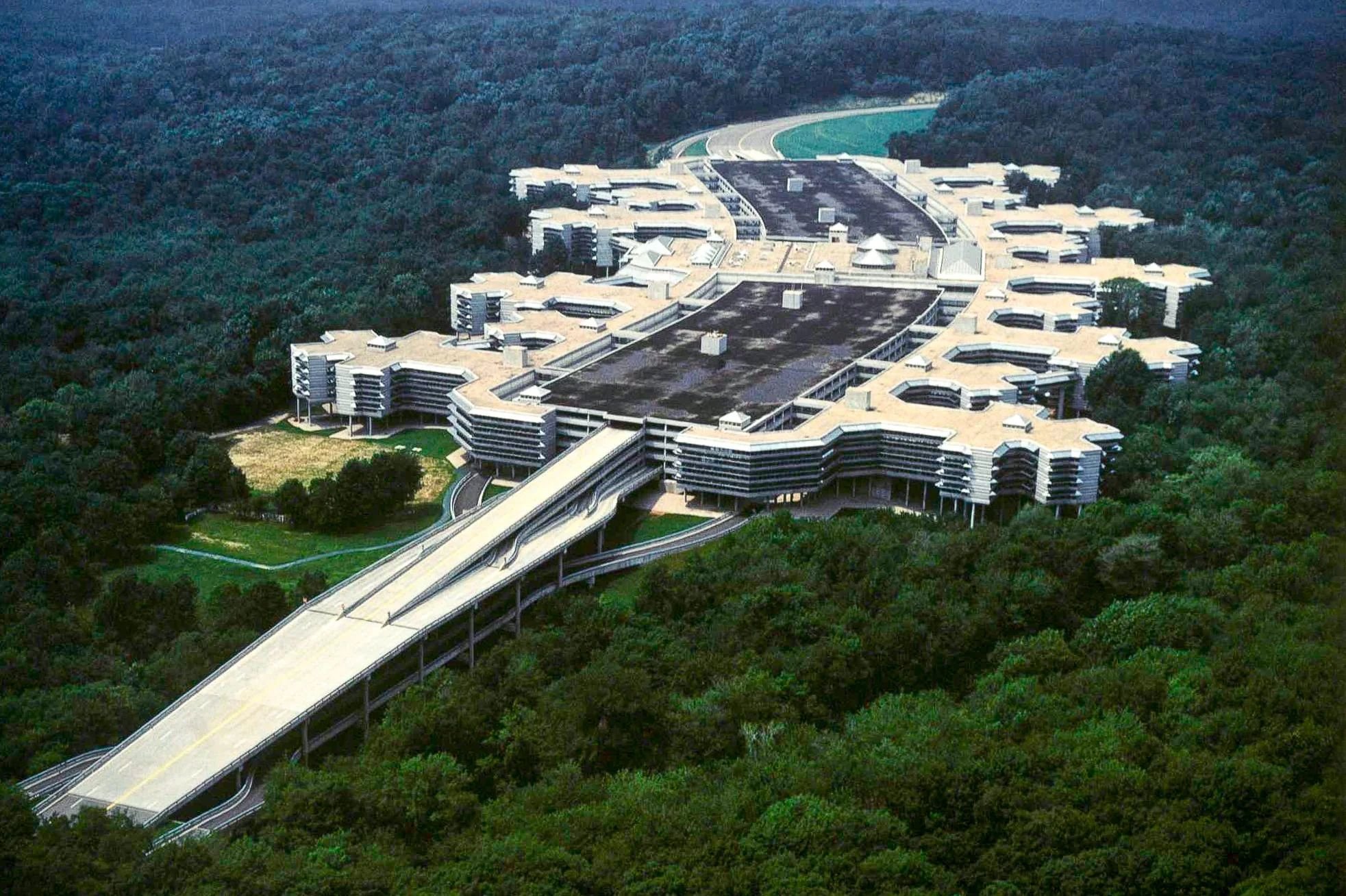
{ Aerial photo ca. 1990; H John Voorhees III / Hearst Connecticut Media }
The design was heralded by its architect, Kevin Roche, as a vessel for collaboration and innovation. In interviews about the design, Roche spoke of the intent of the structure using the same language with which a planned community might be described—he discussed the horizontal architecture as a vessel for collaboration through proximity and access.
You could see your coworkers, you could see your manager, and while you had your own places within the space, you were in the same space together. This would, by Roche’s estimation, lead to good ideas, and good decision-making.
The utopianism and horizontality operated in a facility occluded from view in the hills of Fairfield county, the decisions made in its interior involving only a thin slice of the corporate hierarchy.
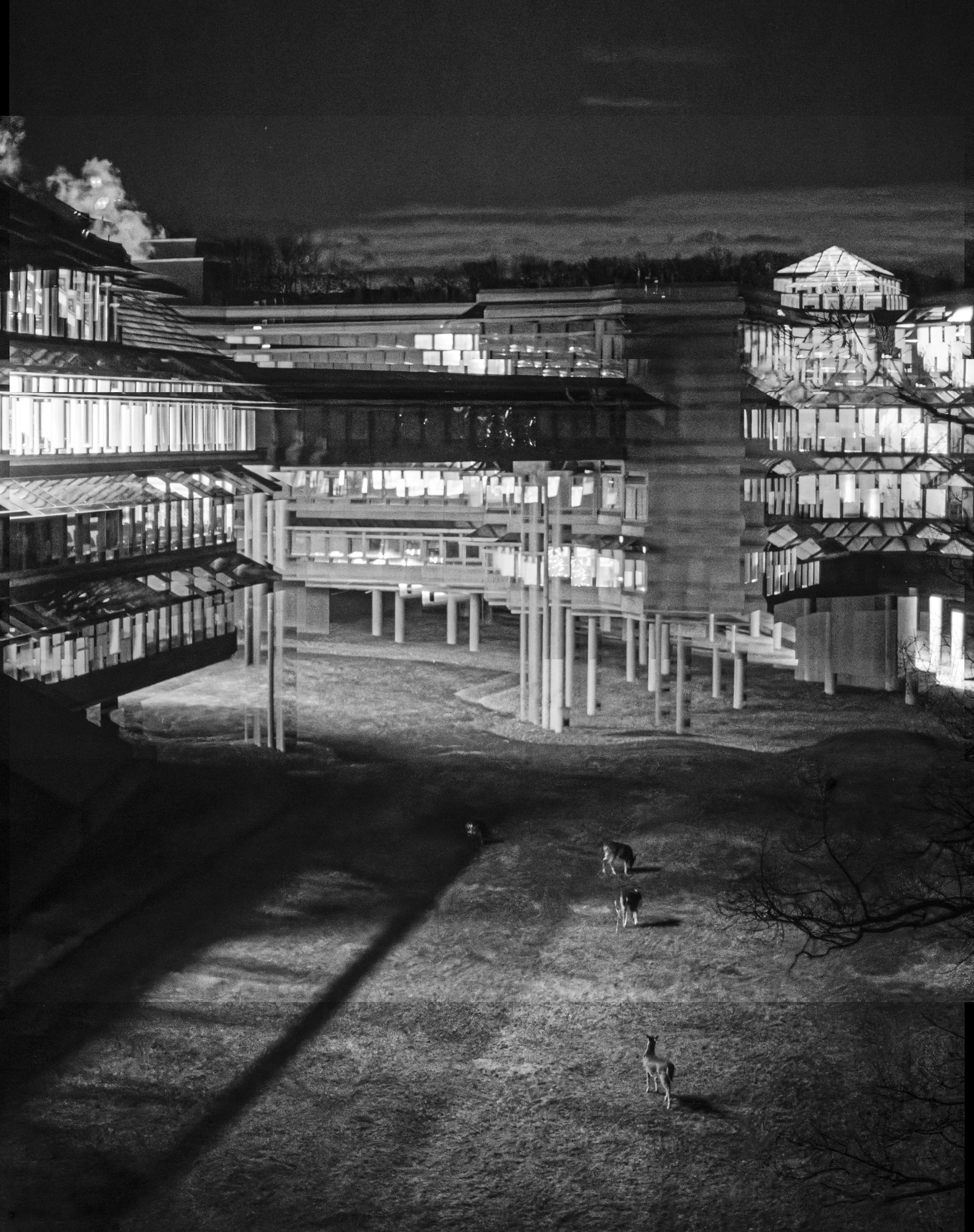
{ untitled, Iris Yaun, 2026 }
It was the early eighties. Neoliberalism was consolidating, and cost-cutting, profit-maximizing business strategies and structures were proliferating. The industrial economy was winding down in the United States, broadly, and the financial economy was ascendant; a web was spun more and more intricately around the globe, one woven of subsidiaries and contractors. Material production, and accountability if applicable, occurred out there, for cheap, while proceeds flowed back here, gratuitously. Union Carbide was a paragon of this.
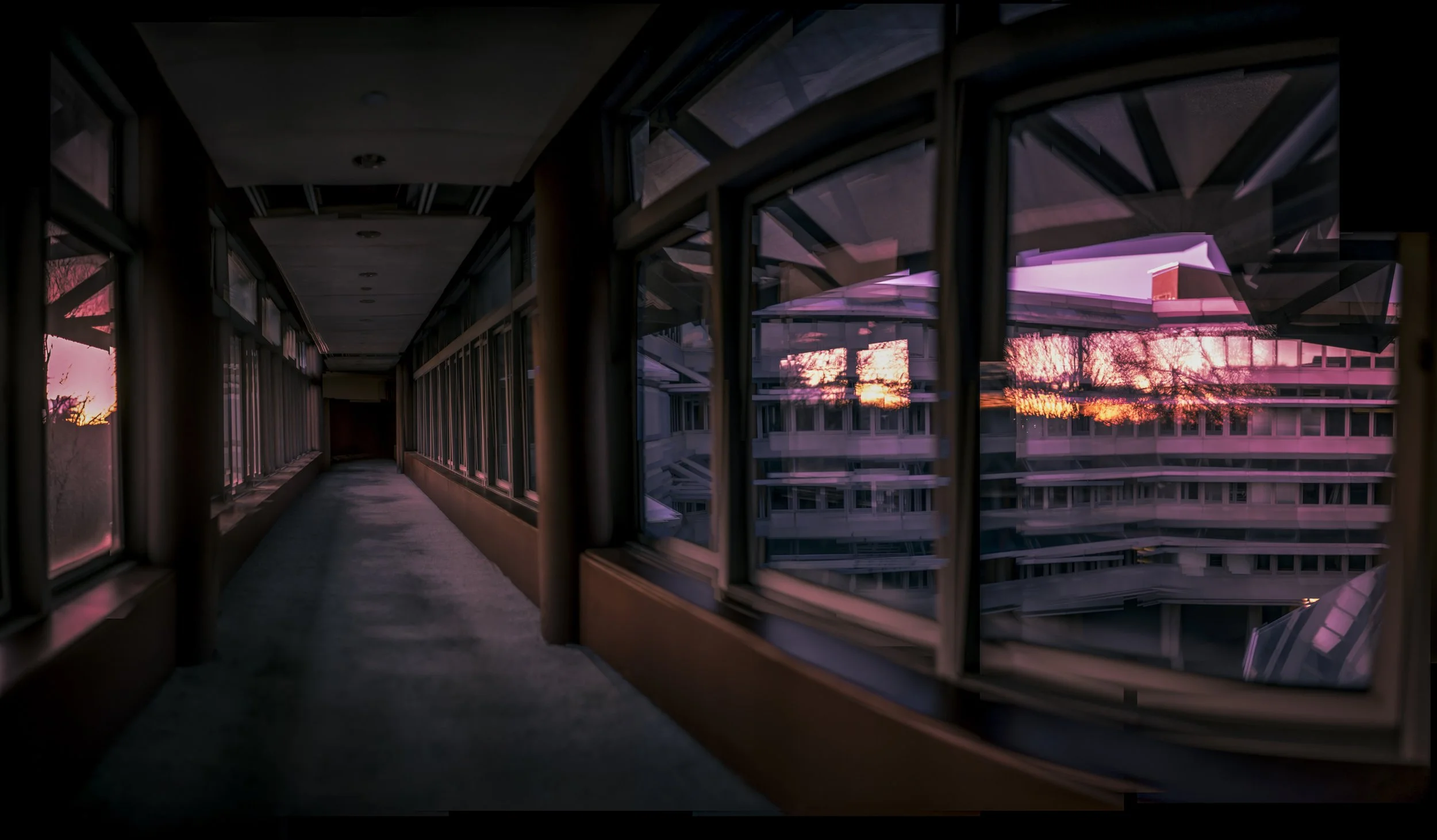
{ nowhen, nowhere, Iris Yaun, 2025 }
A year after moving into their Corporate Center, Union Carbide's Indian subsidiary had a minor but concerning leak at its pesticide plant in the city of Bhopal. Not much became of it at the time—but it was an ominous portent for the low lying plant in the midst of a population center. Negligence at all levels meant that Union Carbide’s plant in Bhopal was approaching dereliction, bereft of numerous essential safety systems, and this minor leak marked the critical point. A disaster was now inevitable.
And yet, production had to go on—then push came to shove.
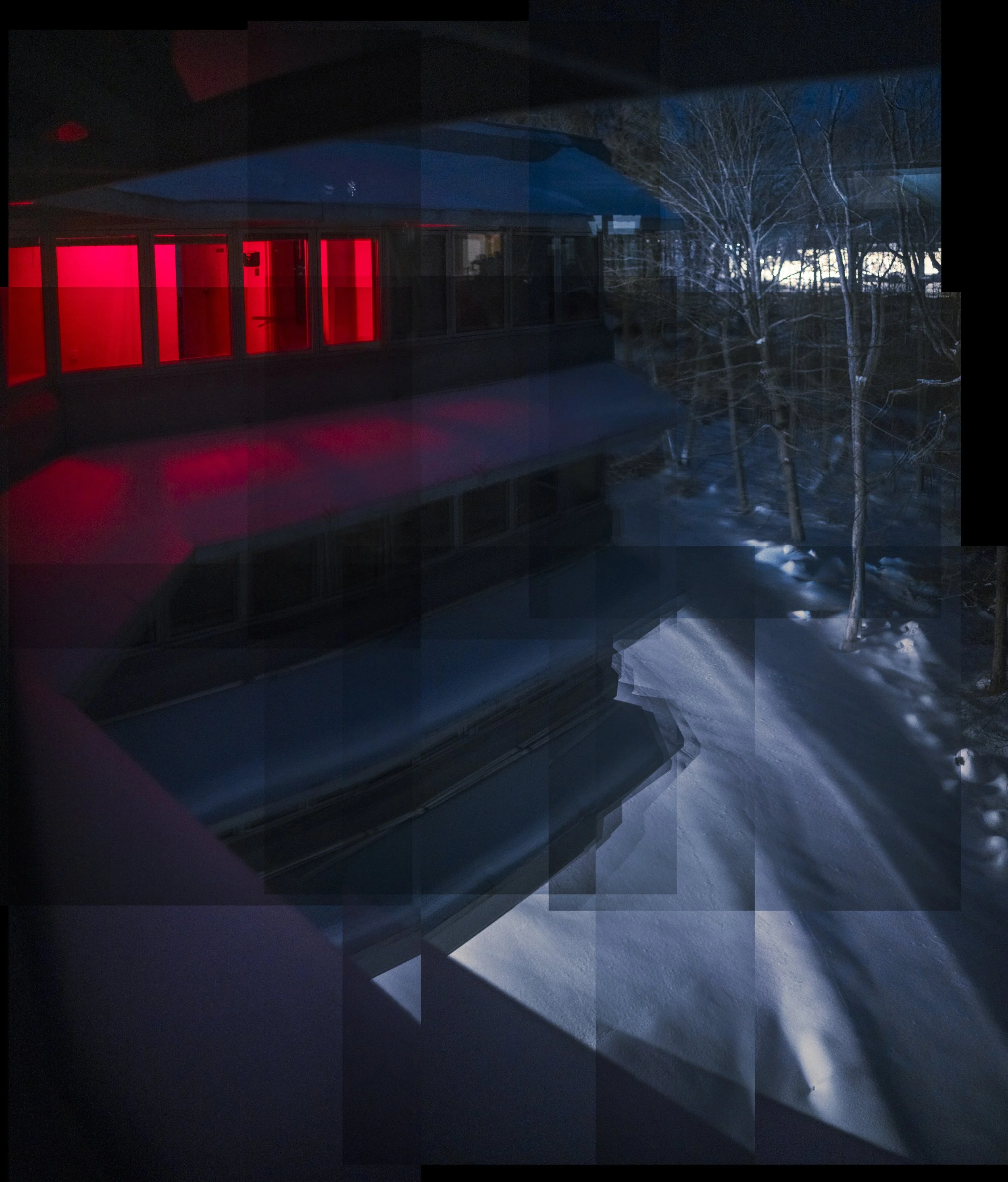
{ untitled, Iris Yaun, 2026 }
In the early morning of December 3, 1984, an aging tank of methyl isocyanate, an intermediary in Union Carbide’s pesticide manufacturing process, ruptured and vented its liquid contents into the atmosphere. 40 metric tons of liquid MIC expanded into multiple millions of gallons of toxic, asphyxiating gas, heavier than air, and wafted across the landscape of Bhopal, India. Thousands died in their first minutes of exposure to the cloud of death. Thousands more in days. Hundreds of thousands lived through their poisoning, affected for the rest of their lives.
Condemnation rang from the Indian government and public. Union Carbide offered $5M in aid, rejected on account of how insulting a sum it was for the worst industrial disaster in history (a designation held to this day), and fought every attempt to collect the billions they fined Union Carbide, ultimately paying $470 million after contesting an initial demand of $3.3 billion.
Rapid downsizing and sale of Union Carbide assets and subsidiaries ensued. Union Carbide left Danbury within two years of the disaster. The Corporate Center was sold.
The snake without a head ceased its twitching, and was scavenged.
Union Carbide was liquidated over the course of years, and then sold to DOW Chemical in 2001, which made the purchase with full knowledge of the liability exposure, at least in theory. The executives of Union Carbide themselves moved on into obscurity, living out quiet retirements.
Not a single person in Union Carbide’s leadership was held accountable.
The then-CEO of Union Carbide was arrested on the scene after flying to Bhopal with a team of engineers. Bailed out immediately, he returned to the US and lived the rest of his life as a fugitive from extradition to India, protected by the US government from consequence. He died in obscurity at a Florida nursing home in 2014.
The only people found criminally culpable in connection with the disaster were seven employees of Union Carbide India Limited, convicted in 2010, twenty-six years after the disaster. These men, many in their seventies, were each sentenced to two years of imprisonment—the maximum the relevant statute allowed—and released on bail the same day. Their appeal has been pending ever since. None has served the sentence.
In the decades to follow, DOW Chemical would refuse all calls for it to clean up the site and adjacent area. Thus, the disaster drags on.
The site of Union Carbide’s plant in Bhopal has, to this day over forty years later, not been remediated. Methyl isocyanate is not the only pollutant; after decades of sloppy industrial chemistry on the surface, groundwater in Bhopal registers mercury levels between 20,000 and 6,000,000 times the mean, and trichloroethane at fifty times the mean. Lead, mercury, DCM, 1,3,5-TCB, chloroform, and more show up in the breastmilk of nursing mothers.
There are victims of the Bhopal disaster still yet to be born, still yet to be conceived.
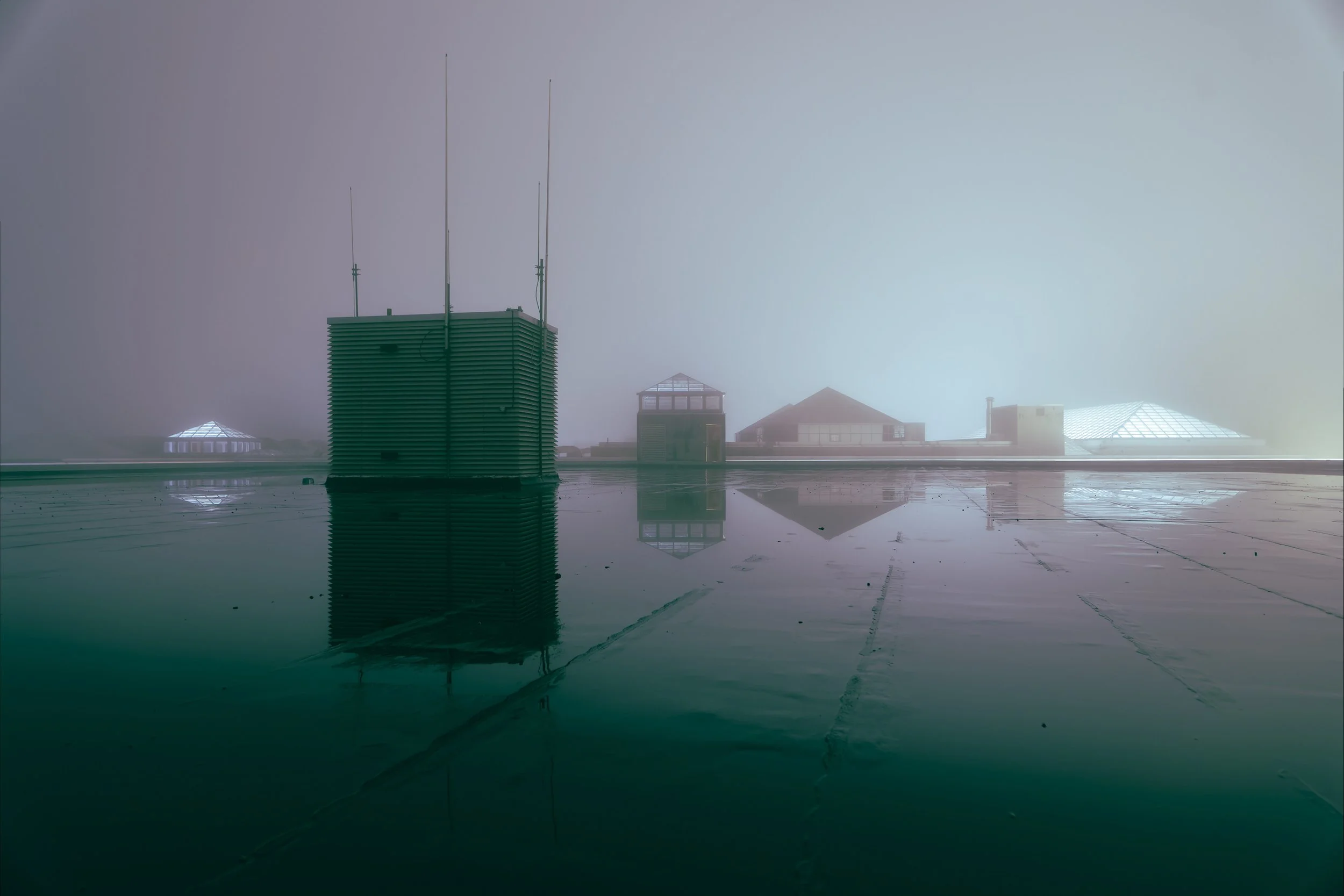
{ śūnyatā, Iris Yaun, 2021 }
The building still stands, all 2,100,000 square feet, but forty years later, it has not been made use of like it was planned to be. The air hangs still over hundreds of thousands of square feet, and has for years. Roche's hopes for his creation did not survive first contact with material reality.
Built for the present equivalent of $600M, this derelict has been shuffled from one private equity or corporate real estate group to another every few years since, the most recent of which being for $18M.
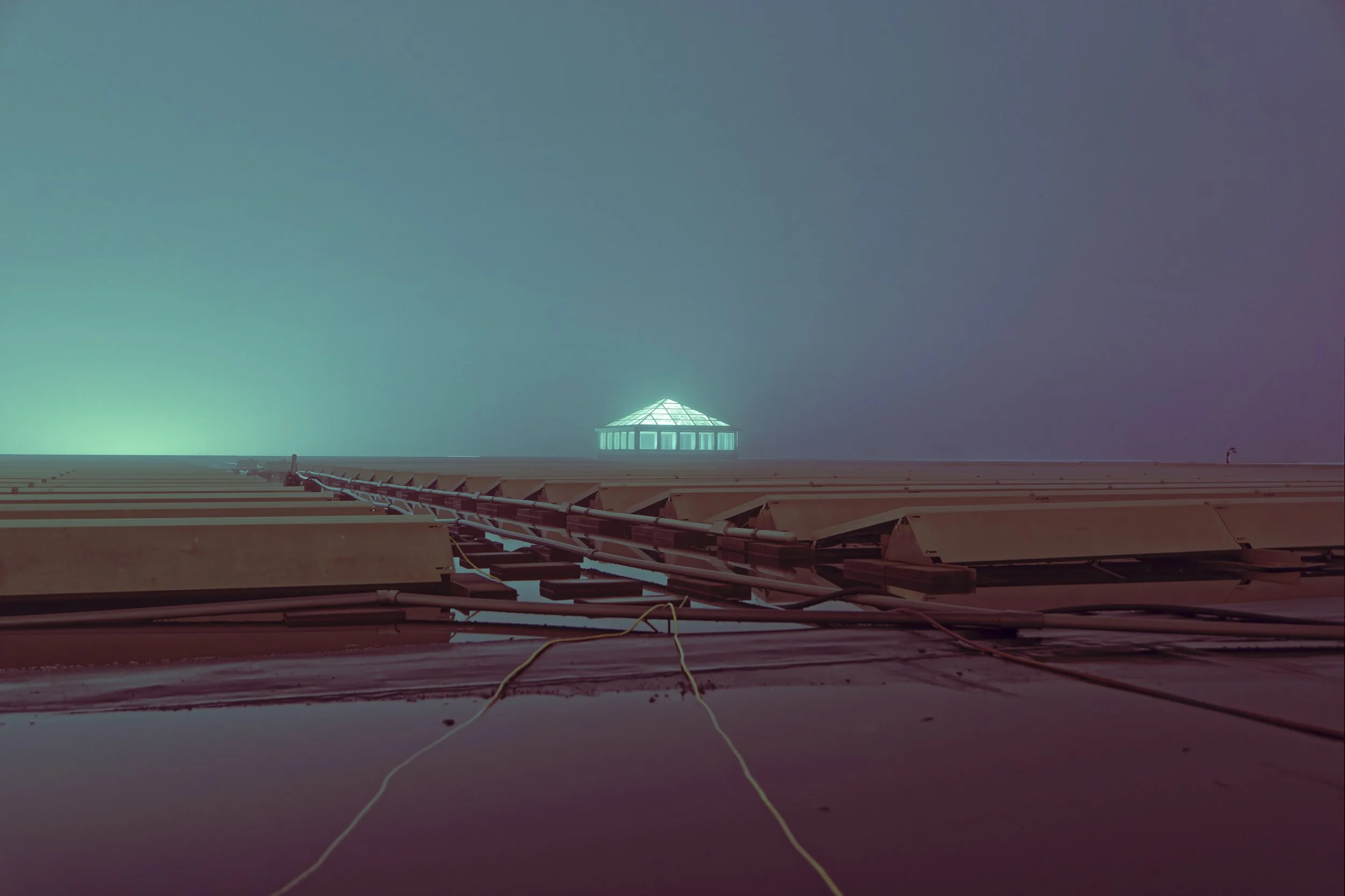
{ nothing, everywhere, Iris Yaun, 2021 }
The early years of the Corporate Center were a flurry of activity by Union Carbide—first moving in and settling, then just as quickly, moving out, followed by a long period of dormancy broken by half starts from various buyers at points. Of late, it actually facilitates a modest amount of activity. Much of the refurbished square footage is taken up by a regional medical organization, a few medical practices, a handful of other tenants of various scales, an event space, and even apartments in one wing.
This usage is something of a reclamation, perhaps, but it is no redemption of the legacy; in practice, it is probably even easier to overlook that this place has a history of any kind if you are going there for a yearly physical and scrolling in a waiting room and answering questions just as you did last year and saying “ahh” and scheduling for next year in one of its doctors’ offices.
In this the banalization of the structure by way of resale and dormancy is revealed. We see that perhaps Roche’s design was successful, in a way he himself may not have understood: it rendered the externality which now overshadows all explicit discussion of Union Carbide totally invisible to anyone inside the building.
Invisible, but inescapable.
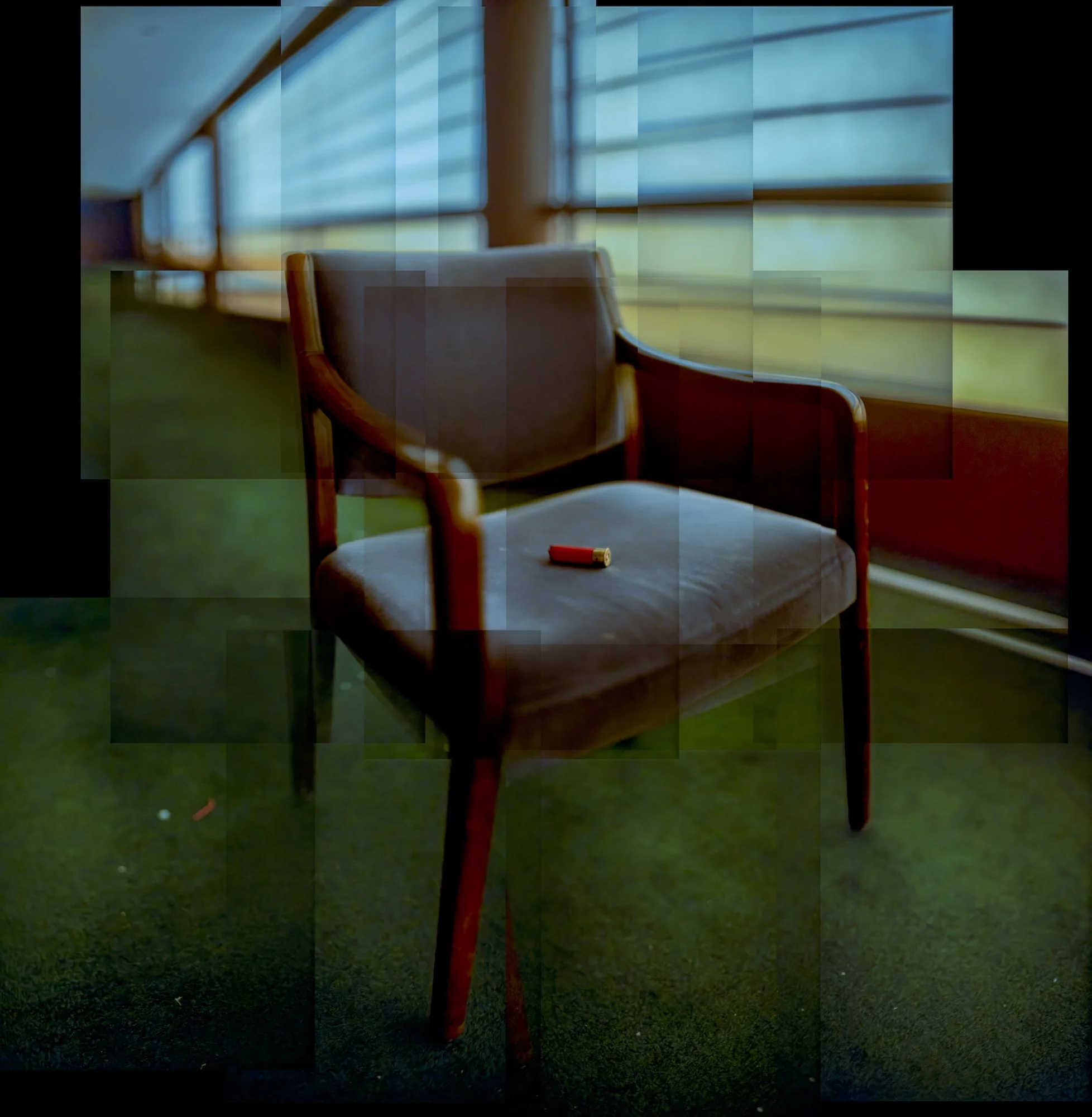
{ spent shotgun shell, no bullet holes to be seen, Iris Yaun, 2026 }
In the evenings nowadays, the deer wander through. Rabbits hop and perhaps even coyotes chase. The leaves sprout and green and foliate and fall and compact and rot into soil under snow. All the while, the sun and stars and moon spin.
And so little takes place on the majority of the square footage. Hundreds of thousands of square feet sit silent, the dust undisturbed, but by the convective tendrils of air spurred by afternoon sunlight pouring through windows onto years-untrod carpet.
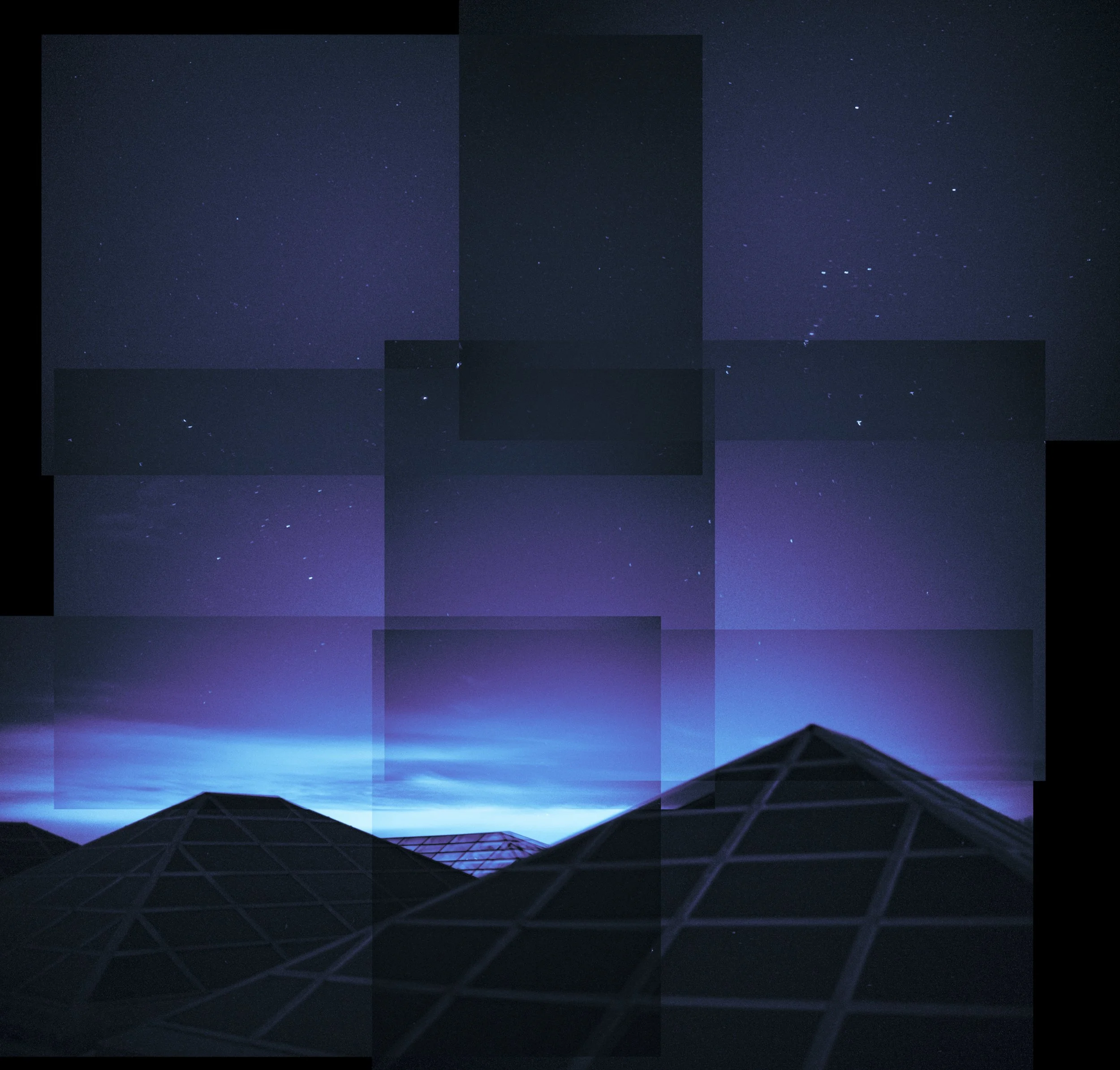
{ matrix multiplication is just birdsong in a different register, Iris Yaun, 2026 }
If the purpose of something is what it actually does in the world, and not just what it is stated to do, then perhaps the Union Carbide Corporate Center at Danbury is best understood as a murder weapon, discarded right at the scene of the crime’s commission—somewhere, it seems, no one bothered to look in the first place, and not for over forty years thereafter.
The Bhopal disaster did not happen; it is still being done.
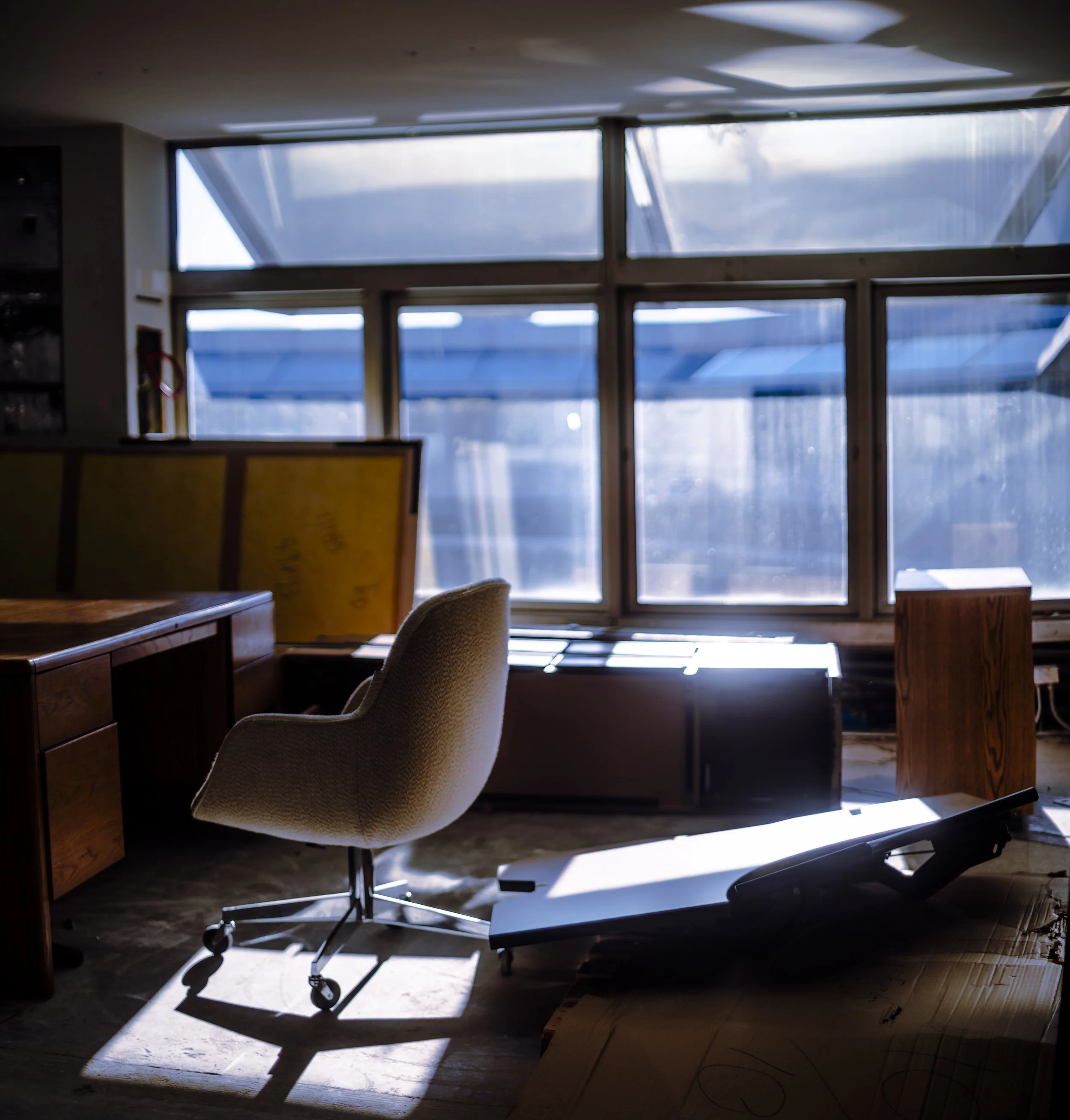
{ stillborn future, Iris Yaun, 2026 }
subglacial consciousness
In other times you’ve been all of the greats. You’ve been all of the leasts too. You’ve been old and young at the same time forever.
In this time, you are, more specifically, a stream, with a little overlap with a child whose fascination was you.
She saw you like perhaps no other had. She saw you for the truths your freestone waters carried, saw universes in the slightly silted sunbeams lighting the soft white underbellies of the creek chubs gold as they darted over the aureus bed of the stream.
She would in her walks by you discover that she was alive, that she was here now, that consciousness too was here, in you and her likewise, observer and observed in reciprocity.
She would immerse herself in your waters and dream of your waterfalls. She would find herself by your flow when she was lost in the swamp you terminated into behind her house when she was alone and her boots got wet and it was getting dark and she hadn’t done her homework yet and it was dinner soon.
She would find in your icy winter shores and in the way you absorbed the snowflakes into darkness by the glow of the mall and airport off the blizzard clouds of her winter childhood a secret you couldn’t keep to yourself, a secret you never bothered to hide.
She would discover that time is a supercritical fluid which condenses into all of Being with every successive breath and heartbeat and firing of the electron transport chain, that the dialectical tension between inhalation and exhalation carved an echoic truth in its tidal rhythmicity, that from her perspective flow and thus change is the truth.
The biogenic magnetites in her brain aligned themselves to the cardinality of your south to north flow, and she traversed the world one step at a time in line with your banks.
Whenever her world turned upside down she came to you. In fact it often would, and you were always there.
Your dappled surface carried her sorrows and worries away, your denizens illustrated her archetypes. You became the world within the world to her.
One summer she found a lead weight in the shallow riffle and an aged net just below your long pool beneath the cataract cut into the berm that once carried an electric trolley over your waters.
She wondered what fishing you was like when you once might have held brook trout, before the warming came and the highway and before it was never dark save for the stars anymore. What the world looked like when you were but a rivulet, when the ice scraped your basin into the hills on its way to the sea.
The choreography of your becoming lent its epochal momentum to hers. Your shores an altar, your forested banks a multifoliate cathedral in which the ritual of her embodiment unfolded.
She once dug out a small spring on your shores, carving over hours one snowy evening with a shovel a basin among roots where the waters of a long slope trickled through the rocks and soil, percolating with a musicality never heard, a rhythm never revealed, that is until she picked up the shovel.
She found on your banks the truth of herself in the midst of all being. She traversed many a strange loop of pondering on your sloped bank, and basked after hopping the rocks beneath the cataract picking berries one summer afternoon when she was ten after vacation and the world glowed anew as the coming evening’s light fell through the trees and the smell of the forest and your flowing waters rang familiar on her nose and she ate your wild salmonberries.
She cries as she writes, and the water molecules of her tears will one day again wind up in your current, and the sun will rise, just as the stars will rise, and the moon and the planets for that matter, and all of Being will glint off your waters in her mind, all of eternity will flow through your freestone course.
And you were one.
